AccessiMind Reader 114-9 production and 114-10 Beta
Explore formatting analysis in the stable production channel and Speech history with a text-only AI flow in Beta.
Production
114-9 · 1621623
Beta
114-10 · 1621624
Package date
11 September 2026
Language coverage
29 language/region configurations
Production
114-9 · Hear text formatting
Receive the font, size, style, underline and colour data exposed for focused text through speech or sound. Optional screen sampling assists colour analysis, while accessibility IPC and focus paths are hardened against freezes.
114-9 / 1621623
phoneRelease · signed
29 locales
Beta
114-10 Beta · Reuse recent speech
Open the last 10 utterances with time and category information, copy an item, ask AI using text-only context, and hear a dynamic estimated percentage while the response is prepared.
Recorded evidence for both signed packages covers release identity, 29 locale resources, Direct Boot reboot, screen-off/Doze/keyguard cycles, service binding and touch exploration. AI results still depend on the selected provider and data exposed by the application.
114-9 Production · 114-10 Beta
Learn settings in 14 detailed chapters
All 15 main settings groups are covered in 14 chapters by combining Training and help with About in the final chapter. The 114-9 and 114-10 Beta features appear inside their owning settings sections.
Includes narrated explanatory slides, selectable captions and a full transcript; it is not a recording of every operation on a physical device.
Speech volume controls the screen reader volume. Text-to-speech settings select the main engine, language, voice and speed. Enable a separate notification synthesizer to choose its engine and voice independently. Battery and charging announcements have their own voice, percentage and time intervals, low battery, connection and full-charge information. Verbosity determines which details are spoken. Sound and vibration configures feedback and the sound profile. An engine must be installed on the phone; appearing in the engine list does not guarantee successful speech. Open Audio and find the main engine selection. Check that notification and battery announcements use separate engine choices. You can listen to the battery preview. Inspect percentage and time intervals; restore any unwanted changes before returning to training.
Keyboard layout, number row, letter size, alternate-character delay, volume-key cursor control and capitalisation personalise typing. Keyboard appearance has its own theme, height, width and custom colours, separate from Interface settings. Sound and vibration feedback levels can be adjusted. Word suggestions, spoken suggestions and a personal dictionary support typing. To use the keyboard, enable and select it in Android input methods. Open keyboard settings and find the number row and letter size. Read whether the number row is enabled. Optionally change it and restore its previous state. Check that the keyboard theme is separate from the settings screen theme.
The notification filter can allow all apps or use allowed and blocked app lists. Entries are interpreted according to the selected filter mode. Time announcements offer an interval, speech or sound effect, effect selection, engine, voice and preview. Quiet hours use start and end times to restrict announcements. Reading notifications requires Android notification access. The separate notification voice is in Audio; live notification testing is in Advanced settings under Automatic diagnosis. Find the filter mode and quiet hours. Without changing the filter, consider which apps can be read. If time announcements are enabled, try their preview. Check how quiet hours can cross midnight, then return with Back.
Call management includes one-finger call controls, volume control during calls and automatic speakerphone. These options depend on the current call state. People nearby may hear a call on speakerphone. Call controls require appropriate phone and screen-reader state. Read each description and choose options that suit your daily use. Open call settings and read the current state of all three switches. Return when you can explain the effect of automatic speakerphone. This exercise does not require starting or ending a real call.
Focus indicator settings choose its thickness and colour. Gestures manages existing assignments, custom gesture creation and saved layouts. Volume-key shortcuts have separate settings. Customise menus manages AccessiMind, reading and navigation menu items. Proximity sensor behaviour and automatic icon or image descriptions are also here. Before changing a gesture, read its current action; avoid accidentally replacing a gesture you rely on to return. Open Customise menus, then inspect AccessiMind menu options. Find whether an item is shown. Optionally change it and restore its previous state. Inspect gesture assignments to identify your current double-tap and navigation actions without reassigning them. Release 114-10 Beta adds Speech history to the three-finger AccessiMind Reader menu. Review the last ten spoken utterances with time and category information, copy an item, or ask AI about it. Its visibility is controlled independently under Customize menus.
The translation switch enables the feature. Engine, source language, target language and copying to the clipboard are separate choices. Required offline language models can be downloaded. With an online engine, text may be sent to its service. Correct source and target languages affect the result. Downloading a model does not make a different online engine work offline. Open the source and target language lists and read their current selections. Cancel without choosing a new value. Explain the clipboard option. This exercise requires neither sending text nor downloading models.
AI settings manage the selected provider, model and connection configuration. Screen or image descriptions depend on device support, provider support and permissions. Agent mode can divide a task into steps; inspect the actions and confirmations shown. Cloud features send content to the service. Do not share private information such as API keys. Selecting a model alone does not prove a working connection or a completed task. Open AI settings and locate the provider and model. Read their descriptions. Inspecting the configuration does not require sending a screenshot or running an Agent task. Return without changing private fields. Ask AI in Speech history sends only the selected spoken text as dedicated context, rather than a screenshot. Choose Explain or type a question. Release 114-10 Beta announces an estimated percentage that rises while the selected model prepares a response; it is waiting information, not a guarantee that the task will finish.
Custom voice commands connect a spoken phrase to a chosen action. You can inspect, add and edit saved commands. Keep phrases short and distinct. Recognition requires microphone permission and a suitable recognition service. A saved command does not guarantee recognition in every environment; test a safe action in a quiet place. Open the command list and inspect an existing phrase and its action. If the list is empty, open the add screen, read its fields and leave without saving. Do not use deletion or message-sending actions for practice.
Per-app profiles customise supported screen-reader preferences for a particular app. Select the app first and check the title to confirm which profile you are editing. Profile preferences are distinct from general preferences. Do not assume every setting supports profiles. Evaluate the effect when switching between apps. Open profiles and locate app selection. If inspecting a profile, check the app in the title. Return without saving or deleting. Mark the step when you can explain the difference between general settings and an app profile.
Tools contains the AccessiMind browser and app shortcuts. The browser supports web navigation. App shortcuts manage saved operations; inspect the destination and steps before running one. Automation depends on the target app state and permissions. Do not use banking, purchases or message-sending flows for training. Open Tools and find the browser and app shortcuts. Inspect the shortcut list, then return without running an automation. Check that viewing a shortcut and running it are separate operations.
The Braille keyboard and Braille display are separate ways to interact. The keyboard supports Braille typing on the touchscreen; the display supports reading and control using a compatible external device. Language, code and connection options are selected in their respective sections. If you do not have a display, skip connection practice. The Braille keyboard may need to be enabled as an input method. Inspect the difference between the two Braille settings. If you use either, locate its language selection. If you have no device, return without pairing; this does not prevent you from continuing training.
Advanced settings includes password speech, labels and automatic labelling, single tap, description order, time format, window delay, smart browsing, typing confirmation, long press and physical keyboard shortcuts. Automatic diagnosis checks service and speech paths; its notification step posts a real test notification and shows progress stages. Copy the report or open an email draft. Sending is your choice. Avoid changing developer settings without understanding their effect. Optionally open Automatic diagnosis in Advanced settings. Listen for the real notification and inspect received, accepted, started and completed stages. Review relevant settings if an error appears. Stop the test or leave with Back. Sending the report is not required. Release 114-9 production places Text formatting feedback under Typing in Advanced settings. Choose speech, sound, both, or off, then independently enable font, size, styles such as bold and italic, underline, and foreground or background colours. Use Text formatting information in Reading controls or the three-finger menu for an on-demand report about focused text. If the application does not expose formatting, Reader does not invent exact details; optional screen sampling or the selected AI provider may assist with colour or visual analysis.
Interface settings adjusts the readability of settings screens. Choose system, light, dark, high-contrast white-on-black, yellow-on-black or sepia themes. Text enlargement combines with the system font size. Bold text, wider line spacing and taller setting rows may help you follow long content. Changes refresh the same screen and are saved. Reset affects only these appearance preferences. Open Interface settings and choose a theme. Read the preview. Enlarge the text and check that long text wraps and controls remain reachable. Optionally reset the appearance, then return to training.
Training and help offers the setup wizard, user guide, gesture practice and feedback routes. This interactive guide dedicates a separate step to each settings group. Go to section jumps to any step; the learned switch is your personal marker. First-run training is optional and can be accessed here later. Open Go to section, visit the previous group, then return here. Toggle the learned switch on and off. Leave training and reopen it through Training and help to check that it resumes at the same step. About shows the installed version, developer information, privacy policy, terms, feedback and community links. In an issue report, include your version, exact steps, expected result and observed result. Do not include private messages, passwords or personal screen content. Links may open a browser or email app. Find and read the installed version. You may inspect the feedback email draft, then return without sending. Mark this step if you have finished learning, or revisit earlier sections. This guide uses fourteen video chapters to cover all fifteen settings groups in the application; the last chapter combines Training and help with About. When reporting a problem, include whether you use 114-9 production or 114-10 Beta, Android version, language, screen, steps and observed result. Never include a password, API key or private screen content.
Menu names, order, visibility conditions and default gesture
assignments on this page were checked against the current
Android settings definitions and the components that own their
behavior.
Verified project state: September 3, 2026, Release 109.
Paths:Settings → Controls → Customize menus
is the actual order in the app.
Defaults: Gestures are customizable. The
assignments below are reset gesture set 0.
Enable the service and review Android’s warning. Two touch
screen readers running together may conflict.
Use the AccessiMind Reader Setup Wizard to check
permissions, speech and Braille.
Open
Training and help → Help and feedback → Practice
gestures
to test gestures safely.
2.2 Focus and activation
Move one finger around the screen to explore by touch.
Accessibility focus moves to the meaningful item under your
finger and announces its name, role, state and relevant hint.
Swipe right or left for sequential navigation. One-finger
double-tap activates the focused item. For split tap, keep one
finger on a target and tap with a second finger. Double-tap
and hold begins a long press or drag.
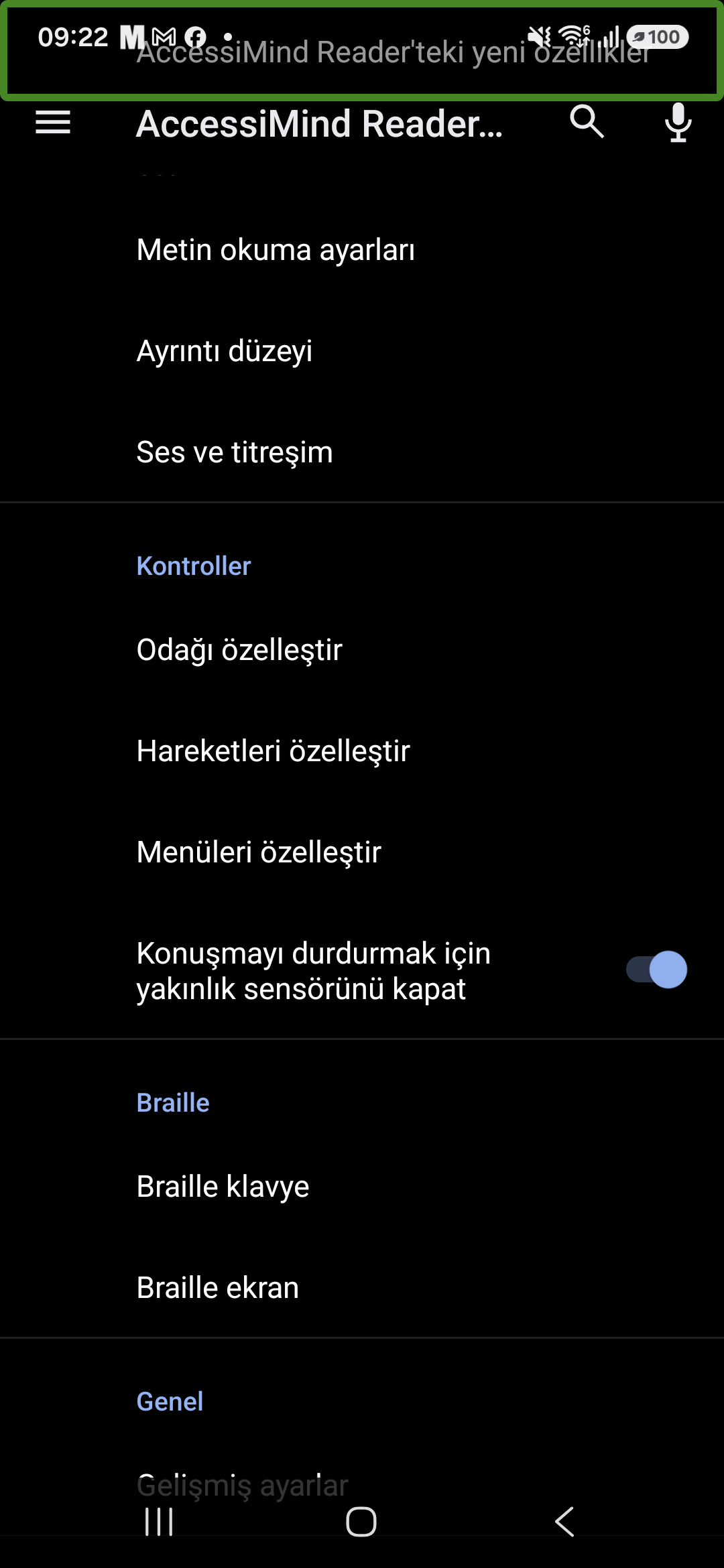
Main settingsImage description: A dark portrait
screen contains the title, search and voice-search
buttons. Sound, Controls and Braille settings are grouped
under headings; a green outline shows accessibility
focus.
↗3
Every touch gesture and its default
Settings → Controls → Customize gesturesThis screen contains Gesture set, Practice gestures, Restore
defaults and every assignable gesture below. Logical
previous/next directions may be mirrored in right-to-left
locales.
3.1 Core gestures
Explore with one finger
Move without lifting to focus and announce the item
underneath.
Double-tap
Activate the focused item.
Double-tap and hold
Start a long press or hold an item for dragging.
Split tap
Keep one finger on the target and tap with another to
activate it.
3.2 One finger: straight swipes
Swipe up
Previous value or action for the selected reading
control.
Swipe down
Next value or action for the selected reading control.
Swipe left
Previous item.
Swipe right
Next item.
3.3 One finger: back-and-forth swipes
Up then down
Select previous reading control.
Down then up
Select next reading control.
Left then right
Scroll backward.
Right then left
Scroll forward.
3.4 One finger: eight angled gestures
Up then left
Home.
Up then right
Open the AccessiMind Reader context menu.
Down then left
Back.
Down then right
Open the context menu.
Left then up
Recent apps.
Left then down
Search the screen.
Right then up
Advanced voice commands.
Right then down
Notifications.
3.5 Two fingers
Single tap
Pause or resume speech and feedback.
Double-tap
Start smart voice typing.
Double-tap and hold
Start text-selection mode.
Triple-tap
Read continuously from the focused item.
Triple-tap and hold
Toggle voice feedback.
Swipe up, down, left or right
Scroll in that direction. Holding two fingers down and
dragging performs direct scrolling.
Two-finger rotor turn
Turn the axis between two fingers like a bottle cap to
change the rotor/reading control. Multi-touch is kept
from leaking to the underlying app.
3.6 Three fingers
Single tap
Open the context menu.
Single tap and hold
Search the screen.
Double-tap
Copy selected text.
Double-tap and hold
Cut selected text.
Triple-tap
Paste clipboard text.
Triple-tap and hold
Unassigned by default.
Swipe up or left
Select previous reading control.
Swipe down or right
Select next reading control.
3.7 Four fingers
Single tap
Practice gestures.
Double-tap
Open the tutorial.
Double-tap and hold
Pass the next gesture through to the app.
Triple-tap
Unassigned by default.
Swipe up / down
Previous / next window.
Swipe left / right
Previous / next container.
3.8 Fingerprint sensor
On supported hardware, swipe up/down on the sensor selects
the previous/next reading control. Left/right are
unassigned by default.
Check a customized assignment: The
summary shown in Customize gestures is authoritative.
Practice gestures announces both the recognized gesture
and its current action.
◌4
Rotor and reading controls
Settings → Controls → Customize menus → Customize reading
controlsSelect a control with the rotor or three-finger up/down.
One-finger up/down then changes the selected value or performs
its previous/next action. Options that do not apply to the
current screen are omitted. Release 107 remembers the user’s
last explicit choice — including Default — across the rotor
and three-finger selector. Temporary contextual controls do
not overwrite that preference.
Actions
Click, long-click, copy and other accessibility actions on
the focused control.
AI actions
Cycle questions about focus, the active window or the full
screen.
Analyze current screen
Cycle Full-screen labels and Label focused control;
double-tap runs the selected action.
Label all screen controls
Batch-analyze supported unlabeled controls on the visible
screen.
Label focused control
Analyze one control with its identity, existing
programmatic name and safe context.
Manage labels for current app
Appears dynamically when the app is selected or has
records and opens that app directly.
App automation
Select and run a saved app action.
Instant translation
Start translation or change target language.
Proofread
Move among spelling and grammar suggestions.
Characters, words, lines, paragraphs
Move through text by that unit.
Headings, controls, links, landmarks
Move among matching elements in supported web content.
Windows, containers, default navigation
Move among windows, list/table containers or individual
items.
Speech rate, verbosity, punctuation
Change speech values with swipe actions.
Language, TTS engine, speaker selection and TTS channel
Cycle available speech options. Speaker selection lists
voices compatible with the active engine and language and
stores the choice per engine.
Open: three-finger single tap Customize: Settings →
Controls → Customize menus → Customize context menuEach switch controls one item. A contextual command is also
hidden when the current item cannot support it.
5.1 Actions for the current item
Spelling/grammar suggestions when the
cursor is on an error.
Actions: copy, paste, select and
item-specific commands.
Links inside the focused item;
Page navigation for multi-page content.
Add or edit label for eligible unlabeled
items.
Describe image and
AI actions.
5.2 Navigation and reading
Navigation and Edit navigation options; Read from top/current;
copy, spell or repeat last phrase; Verbosity; Spoken language;
TTS engine; Speaker selection; TTS output channel; Translate focused item; Volume
settings; Audio ducking; Sound feedback; Vibration feedback.
5.3 Featured tools
Analyze current screen opens the
full-screen/focused-control submenu.
Label all screen controls and
Label focused control are direct entries.
Manage labels for current app is dynamic.
Copy text, Notifications, Search the screen, List links
in text, Hide/show screen
and Advanced voice commands.
5.4 Other
AccessiMind Reader settings, Android text-to-speech settings,
System actions and Braille display settings.
⚙6
Every setting: exact location and purpose
The top-left Menu button opens the Settings sections
navigation drawer, whose sections are focusable native
buttons. Activating a section closes the drawer and opens
that section. While the drawer is open, Back closes it first.
“Search settings” and voice search
search setting names and descriptions; selecting a result
opens its section and setting. The source-defined section
order follows.
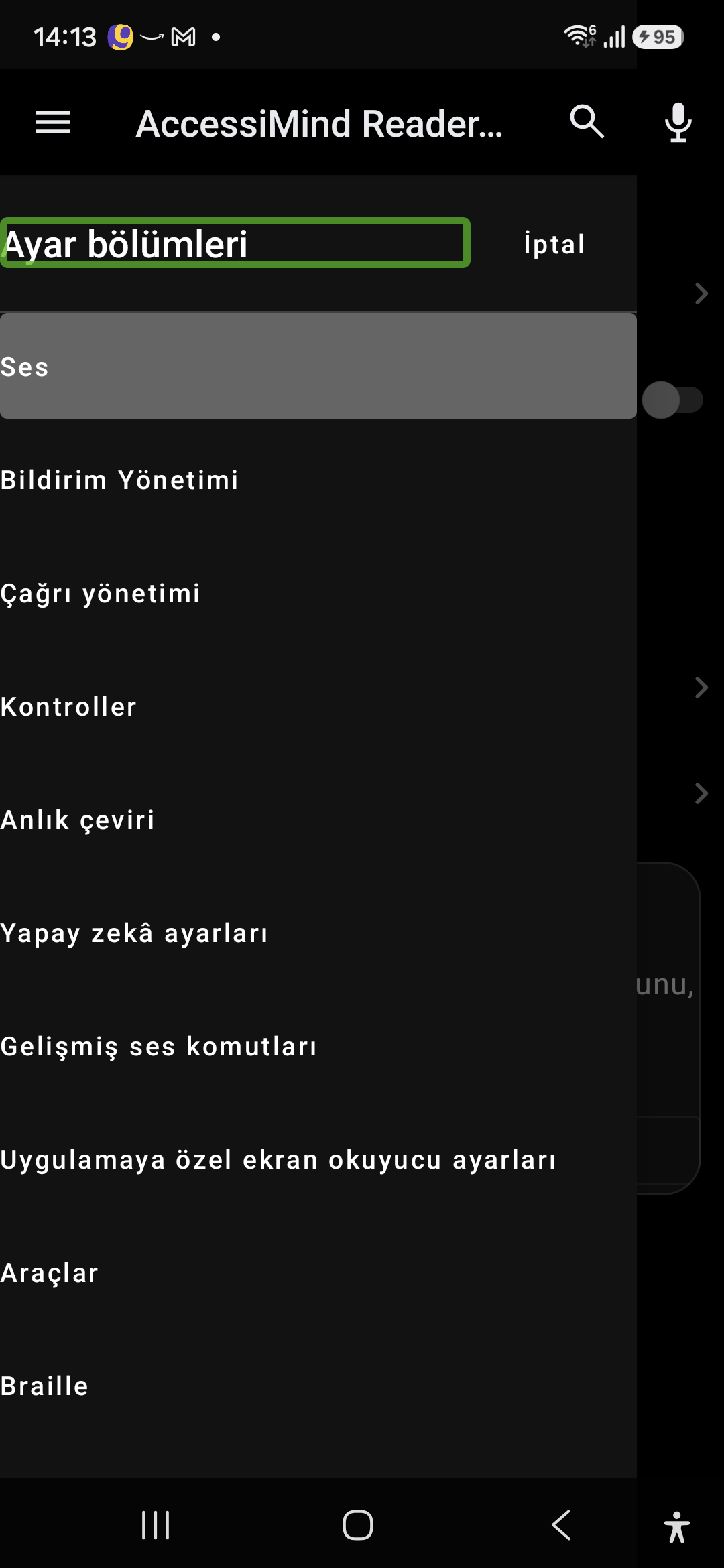
Settings sectionsImage description: A drawer opens from
the left over dark Settings. Audio is focused; notification,
call, controls, translation, AI and Braille sections follow
as large buttons.6.1 Audio
Speech volume
Adjusts screen-reader speech relative to system audio.
Text-to-speech settings
Opens Android engine, language, rate and voice
settings.
Second TTS for notifications
Reads notifications with an engine and compatible voice
separate from the main screen-reader speech. Enabling
it reveals Notification engine and Notification voice.
If notification access is missing, settings identify
the permission; if the selected engine cannot
initialize, speech safely falls back to the normal
path.
Verbosity
Preset plus hints, containers, item counts, element
type, window names, screen-off notifications, pitch
changes, phonetic letters, touch/physical keyboard
echo, capitals, progress, element IDs and punctuation.
Sound and vibration
Accessibility, music, system, ring, notification and
alarm volumes; TTS channel; speech rate; sound
feedback and volume; ducking; vibration. Hold one
finger on screen plus a volume key for announcement
volume; three-finger up/down changes speech rate.
6.2 Notification management
Filter mode (allow all, allowlist or blocklist);
allowlist; blocklist; periodic time announcements and
interval; quiet-hours switch, start and end. Equal
start/end disables quieting.
6.3 Controls
Customize focus
Thick borders and Default, Red, Orange, Yellow, Green,
Blue or Gray.
Customize gestures
All gesture assignments, two gesture sets, practice
and reset.
Volume-key controls
Enable custom controls; assign volume-up/down short
and long presses and text-cursor unit. Off preserves
Android behavior.
Customize menus
Separate context-menu and reading-control visibility.
Proximity sensor
Stop speech when the phone is brought close.
Image and icon descriptions
Automatic image, detailed image, automatic icon and
text-in-image descriptions.
6.4 Instant translation
Enable; online Google/on-device engine; copy to clipboard;
source language; target language; download offline packs.
Translation runs only when requested from its menu/rotor
command.
6.5 AI settings
Gemini Voice Command; Google AI Studio API key; Gemini
model and refresh; use on-device Gemma; download/remove
the approximately 2.6 GB model; AI system instruction;
send a cropped focused-item image. The API key is
encrypted with Android Keystore.
6.6 Advanced voice commands
Choose recognition language. Map a trigger phrase to an
app, system action (Back, Home, Recents, Notifications,
Quick Settings, All apps, power dialog) or supported
AccessiMind action. Open an existing command to
edit/delete it.
6.7 Per-app screen-reader settings
Add an app, save the foreground app’s current settings,
and manage Saved apps. Each profile reports enabled state
and setting count; an enabled profile is applied when that
app opens.
6.8 Tools
AccessiMind Browser: article mode,
bookmarks, voice search and on-device AI summaries.
App automation: app-specific actions,
conditions and bounded repeats.
6.9 Braille
Braille keyboard opens on-screen Braille
training/settings. Braille display opens
connected-display, table and connection settings.
Availability depends on hardware.
6.10 Advanced settings
Speak passwords
Password speech without headphones.
Custom labels
Manually created accessibility labels.
Smart automatic labeling
The actual entry point for app selection, suggestions
and per-app label management.
Single-tap activation
Activate the focused item with one tap.
Element description order
Order of name, role, state and other speech parts.
Setup Wizard; Tutorial and user guide; Help and feedback;
Contact developer. Practice gestures announces current
assignments.
6.12 About
Version/developer; Privacy; Terms; feedback email; Google
Group and subscription; Engelsiz Android community.
✦7
AI and smart automatic labeling
Correct path: Settings → Advanced settings → Smart
automatic labelingConfigure the provider separately at
Settings → AI settings → Gemini settings.
7.1 App selection and consent
Enable the feature and add apps under Selected applications.
For cloud analysis, review and grant per-app consent; it can
be revoked later.
A suggestion is bound to app, control identity and safe
context.
7.2 Manage one app’s labels
The screen shows pending/applied state. Each label offers
Apply, Edit and Delete. Management actions import/export only
that app’s labels, remove the app, clear all of its labels and
grant/revoke cloud consent. Import validates the file and
offers replace or keep-current conflict handling.
7.3 Screen analysis
Analyze current screen contains
Label all screen controls and
Label focused control. Full-screen mode
collects supported unlabeled controls in the visible window
only. Focused mode rechecks identity, existing programmatic
name and context; it will not apply a result to a stale focus
target. Both actions are also available as reading controls.
Review results in the app-specific manager.
Safety: A reliable app-provided accessibility
name takes priority. AI can be wrong; verify financial,
health, identity and confirmation controls against the screen
context.
⌕8
Tools, search, copy and automation
8.1 Search the screen
Search text or list buttons, text and other supported target
types on the current screen; choosing a result moves focus to
the real item.
8.2 Copy text
Copy focused text or the bounded range between two focus
points on the same screen. Password fields are excluded and an
unfinished range times out.
8.3 Notifications
The menu tool lists active notifications, filters by source,
opens or copies them. Notification management settings instead
govern automatic speech; these are distinct.
8.4 App automation
Open
Settings → Tools → App automation.
Create shortcut; define the app, actions, conditions and
bounded repeats.
Run it from the library or enabled App automation reading
control.
Check the target app and condition to avoid running on the
wrong screen.
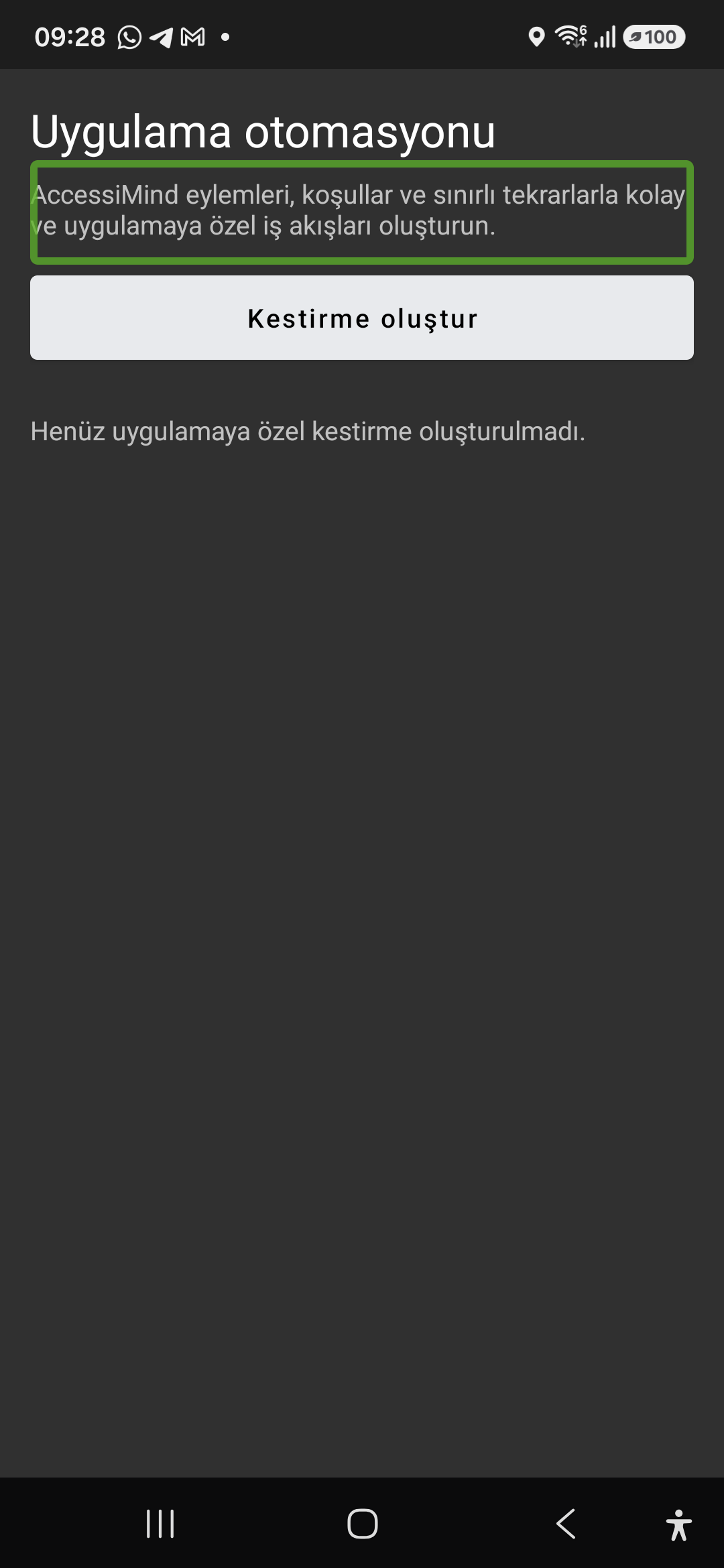
Automation libraryImage description: Below the back button
and title are an explanation, an outlined Create shortcut
button and an empty-state message.
?9
Troubleshooting
9.1 A gesture does something else
Check its current summary and gesture set in Customize
gestures, then test it in Practice gestures.
9.2 A menu item is missing
Check its switch in Customize context menu or Customize
reading controls. Current-app label management also requires
that the open app is selected or has stored records.
9.3 AI analysis does not start
Check the Gemini key/model or Gemma download/verification, app
selection and per-app cloud consent when required.
9.4 Report an issue
Email sarperarikan@gmail.com
with app/Android version, screen name, exact gesture or menu
path, expected result and what was announced. Never send API
keys, passwords or private screen content.